

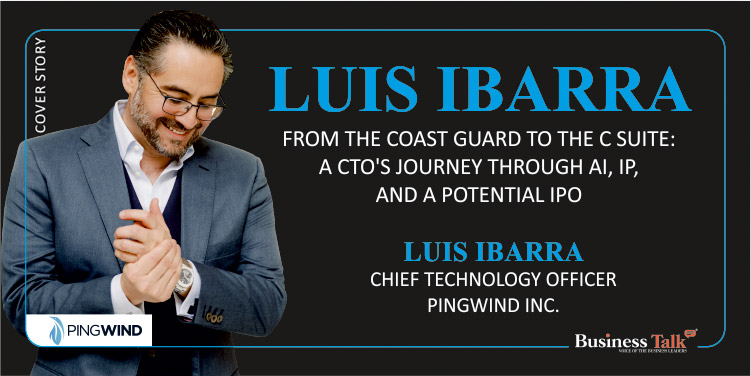
2026 is going to be a defining year for business leadership. As the world ushers in a wave of unprecedented digital evolution, the year promises new technological leaps, developments in AI acceleration, and cutting-edge innovation that will further reshape industries. In this new era of transformations, the spotlight will be on leaders who can evolve from decision-making to becoming “Architects of transformation.” These are the leaders who can seamlessly blend technology with vision to shape the digital landscape. Luis Ibarra, the dynamic CTO of PingWind Inc., is one such technological savant and visionary.
He brings a rare fusion of technical expertise and ethical conviction in the technology space. A Coast Guard Veteran, he views leadership with an operator-like mindset: Mission first, people always, and tech that does not break under pressure. As a technologist, he brings two decades of expertise building mission-critical systems for Fortune 500 companies and federal agencies. The strong background helps him champion innovations as a discipline to drive advancements in AI, cybersecurity, and cloud. He also takes a deep interest in empowering young talent, creating environments that encourage experimentation and turning challenges into opportunities.
How a “Nerd” saw a Gap and Filled It
No two leaders are made from the same mould. While some are content to follow trends, a few select individuals believe in setting them, and Luis belongs in the latter. Even as a kid, he was that nerd who would take apart hardware and then teach himself to make simple programs. He was driven by a thought, “I want to understand how systems work – and then make them better.” When he immigrated to the US in the 90s and joined the US Coast Guard, he realized that technology is mission-critical with real-world consequences. If systems went down, operations suffered, and teams were affected. This realization compelled him to think deeply about reliability, resilience, and lives on the other end of a screen.
But what really nudged him into leadership was a visible disconnection. “Incredibly smart engineers working inside organizations were stuck in reactive mode, always chasing the next RFP or short-term contract,” he says. Instead, he sought to create a company that invested in R&D and IP as much as in execution. The pivotal moment came when the CEO of PingWind, Aaron Moak, invited him to be his company’s CTO. Luis, however, was clear about what he wanted. “If this is a traditional federal CTO role where I spend my days buried in RFPs, I’m not your guy,” he said. “If you want a true nerd CTO focused on building products, filing patents, and making long-term tech bets – then I’m in.” Aaron agreed, and that is how Luis entered business leadership.
From there, Luis became an integral part of PingWind’s growth. He and other leaders, Lucy Martin (VP of Growth) and Efe Lind (VP of Solutions), worked together to get their own RFP machine. And that is how they carved their own R&D arm, QWind, and pWind Labs, their innovation engine. The company evolved into something more than just another government contractor. Its mission centres on helping clients “Secure. Modernize. Optimize” and build for a broader market that investors would love to focus on.
Redefining Federal Tech Globally
PingWind is a certified Service-Disabled Veteran-Owned Small Business (SDVOSB) offering high-quality, cost-effective enterprise technology solutions. It has a federal-grade delivery engine consisting of cybersecurity, cloud, software engineering, and supply chain solutions to mission-critical organizations. The solution is certified by governance and quality stack, such as ISO 9001 for quality management, ISO 20000 for IT service management, ISO 27001 for information security, and CMMI Level 3 for both services and development maturity. They also have a CMMC Level 2 Certification, which enables them to manage controlled unclassified information under strict cybersecurity laws.
On the other hand, with QWind and pWind Labs, the company focuses on AI, High-Performance Computing (HPC), and quantum architectures. A good example is their QWindPx platform – a patented prompt repository that treats AI prompts as assets instead of disposable chat inputs. Beyond QWindPx, PingWind also has additional AI- and IP-focused patents in the pipeline, reflecting a deliberate strategy to build a portfolio of protected innovations rather than one-off tools.
The offerings give PingWind a strong grip on areas of cybersecurity and threat Intelligence, Digital transformation and IT Modernization, Supply chain and risk management, and lastly AI-driven operations and advanced analytics. The company works with the U.S. federal agencies, offering services under multiple vehicles while also supporting broader enterprise and consulting needs. With a decade of successful business, the company has grown into a team of 400 employees across 30+ states. PingWind is also pursuing ISO/IEC 42001 certification, which is the emerging AI management standard. All of this collectively moves the company from “A Capable Contractor” to “An AI- and IP-driven company” with governance credentials that matter in regulated industries.
AI, IP and the Next Frontier in Legal Tech
Over the last decade, the technology landscape has undergone a structural shift. Once siloed and on-premise systems are now operating inside cloud-native, AI-augmented ecosystems. Nowhere is this more visible than in legal tech. Companies like LexisNexis and Thomson Reuters have built enormous moats around proprietary legal content and research workflows. In other words, platforms that sit at the intersection of law, data, and workflow have already proven they can support substantial, long-term value creation. This helped their parent companies earn trust and become worth tens of billions of dollars. When AI arrived, startups like Harvey and August raised millions almost overnight by promising AI-powered workflows. Not to mention, courts and law firms are asking debatable questions: “If an idea was assisted by AI, who is the inventor? How do you prove human contribution? How do you avoid forfeiting IP to the public domain?”
PingWind recognized these signals early. Knowing the stakes in federal and enterprise environments, the company didn’t seek to become another run-of-the-mill contractor chasing RFPs. Instead, it has focused on building a dual engine: It created a federal-grade delivery organization, combining CMMC Level 2, CMMI Level 3, multiple ISO Certifications, and an innovation arm designed to govern how organizations create, protect, and validate AI-assisted ideas.
This combination keeps the company competitive. It builds relationships by understanding how clients are already using AI and their challenges. It listens to clients first, builds with them rather than for them, and stays completely transparent about its certifications, patents, and use of AI. This approach not only helps cut through the noise but also keeps it grounded and aligned with the industry’s changes.
A Unified Infrastructure for AI, Cloud and Quantum Innovation
From federal institutions to business enterprises, AI and cloud have reshaped the foundation of how these industries operate. Slow and document-heavy processes have become data-rich and model-driven ecosystems. Large language models are pushing this shift even further by enabling natural language to be the programming interface. Today, a prompt behaves almost like a high-level algorithm. You can ask an AI to summarize case law, sketch a system architecture, or even design a safer bracket. But with that power comes a new set of risks around IP ownership, data security, and need for stronger governance.
PingWind intends to look beyond this hype cycle and focus on how these technologies fit together. “Our view of disruption comes from combining elastic cloud architectures, AI that can interpret and generate knowledge, high-performance, and quantum computing for complex optimization and cryptographic problems,” explains Luis. That’s the architecture the company is moving forward with, and QWindPx is one of the first concrete building blocks of this journey.
The platform treats prompts as algorithms and routes them through a structured process: to large language models for inference, to internal repositories for uniqueness checks, and to patent systems for IP screening. Over time, the same user leverages quantum resources, especially around portfolio optimization and verifying the security and origin of data. Luis says, “I’m building for a future where AI orchestrates the workloads and quantum computing targets the hardest problems at the edge of complex systems.” As quantum and more advanced HPC become practical for certain classes of problems, Luis intends to position QWindPx as a solution to make sure the IP generated along the way is captured and governed with utmost transparency.
Not the Average “Business as Usual” CTO
In federal tech, the comfort of “Business as usual” is hard to resist. Most organizations default to the safest model: Expand proposal teams, chase RFPs, and optimize for quarterly wins. Luis chose a different path. Instead of becoming another contract-driven machine, he pushed PingWind to invest in R&D, labs, and assets like QWindPx. These moves didn’t show immediate revenue but fundamentally changed what a company is capable of. That shift wasn’t just strategic; it was cultural. Asking teams to think like a commercial product company inside a mission-driven federal environment means pulling them out of comfort zones and toward a mindset built around long-term value creation.
That tension shaped his approach to leadership. He understood that innovation in AI, quantum, and HPC can’t flourish if the team is consumed by the day-to-day noises. At the same time, abandoning the core business is not an option. As someone wired to disappear into a lab, Luis encouraged the team to operate across both points: current mission and future roadmap. His leadership hinges on clarity, trust, and discipline, especially when navigating an environment where the technology, regulation, and expectations shift faster than most organizations can adapt.
What ultimately sets Luis apart is his relationship with risk. He treats it neither as something to fear nor something to chase recklessly, but as something to engineer. His guiding question is, “What happens if we don’t do this?” This keeps the company from stagnating in a field where inaction can be fatal. He approaches risk in layers: protect the stable base, then use controlled experimentation to explore the frontier.
Building a Purpose-Driven, People-First Environment
Luis’ leadership is anchored to two worlds: the camaraderie of the Coast Guard and the curiosity and humility of a lifelong nerd. He understands that people perform best when they know why their work matters, instead of chasing KPIs. It is also crucial to understand that federal tech expects a lot: secure code, thoughtful design, rigorous documentation, and all that comes with plenty of mistakes. As such, he ensures there is room where people can learn from failures and setbacks alike. Luis also believes in diversity and shows a deep interest in working with other veterans, underrepresented groups, and people from outside the usual tech pipelines.
Another quality that sets him apart is his ability to lead from the front and lift from behind. Whether it’s staying close to the code and architecture, he tries to model the curiosity and seriousness he expects from the team. “A mentor once told me,” he says, “Be visible in the hard things, invisible in the credit.” It keeps him grounded and stay up front during technical reviews or early product reviews. However, when something ships, he lets the team shine under the spotlight. Such leadership values create an environment where people stay, grow, and push boundaries of what can be built together.
The Team’s Playbook: Experiment, Learn, Repeat
Innovation and learning are the two core pillars that keep PingWind functioning as a unit. The team works in an environment without friction to experiment and raise the value of learning, even when the experiment fails. It allows engineers and researchers to explore new ideas, whether it is using large language models, orchestrating workloads across cloud and HPC, or what quantum technology might bring into the mix. Luis personally has a diet for technical reading and stays plugged into what’s happening with companies like RELX, Thomson Reuters, and legal-AI startups in their adjacent spaces.
He also embeds learning in their operating model. The R&D centres act as training grounds where engineers rotate through projects that expose them to new tools and paradigms. Everyone gets to practice deliberately with real stakes for hands-on learning with concrete output. They also run regular sessions where teams present what they’ve learned about AI safety, about IP risk, and about performance tuning in HPC environments. This combination of experimenting and deliberate learning keeps the team technically sharp and undeterred by any wave of change.
Progress Measured by Turning Points
PingWind’s growth is defined by turning points over milestones. While many firms in the federal tech focus narrowly on RFP cycles, PingWind chose a more difficult and more meaningful path: to invest in innovation, patents, and active IP in their pipeline. The efforts gave birth to QWind and pWind Labs, and secured a patent for QWindPx, with additional patents currently being prepared as the company continues to formalize its AI and IP infrastructure. Alongside that innovation, they have built a rigorous foundation of trust with ISO and CMMI certifications for their innovative platform. Now, they are pursuing ISO/IEC 42001 certification for managing AI deployment.
On a personal level, Luis is proud of staying close to his nerd roots instead of drifting into managerial work. “Any accolade I get, such as being named a ‘Leader to watch,’ is really a reflection of a lot of people doing great work together,” he says. Understanding how legal and AI platforms are valued globally, he looks forward to what QWindPx and broader AI infrastructure could become. For Luis, the success of multi-billion-dollar platforms in adjacent spaces is less a comparison and more a confirmation that the category itself is capable of supporting outsized value when built on strong governance and IP. This is proof that they’re building something with long-term potential.
Shaping the Future of Federal Tech
Over the next decade, Luis hopes that PingWind, especially QWind, sits at the centre of how organizations orchestrate AI, IP, and HPC in secure, regulated environments. He points out that the next wave of transformation won’t be about generating more output, but about managing the entire ecosystem. Companies will need a suitable system that can automatically choose the right model, data, and IP constraints. AI-assisted innovations will push IP law into the mainstream, and organizations will need clear, safe ways to prove who contributed what.
QWindPx is positioned to become that control plane. The idea repository will evolve into a platform that integrates across multiple providers and offers transparent provenance trails for regulators, courts, and enterprises. Luis concludes, saying, “I can see QWindPx becoming a platform that stands on its own, whether as a spin-out, a strategic acquisition, or even the foundation of a future IPO.”
PingWind Inc. on Social Media

Business Talk is a digital business magazine that caters to CEOs, Entrepreneurs, VC, and Corporates. While working with entrepreneurs and business executives, we focus not only on their achievements. Our mission is to shed light on business entities, including their innovations, technological benchmarks, USPs, and milestones/accolades.